
Life in the 1950’s and 1960’s Life Around Your Street — Part Three
Part of our Life Around Your House series
Before supermarkets, online shopping and home deliveries became part of everyday life, many of the things we needed came directly to our streets.
The fish man, the butcher’s boy, the ice cream seller, the chimney sweep and the window cleaner were familiar visitors to neighbourhoods across Britain. Their arrival was often announced by a voice, a whistle, a bicycle bell or, later, the unmistakable chimes of an ice cream van.
In this third and final part of Life Around Your Street, David Wardell recalls the traders, workers and other familiar visitors who came to the doors of homes in the 1950s and 1960s.
These memories offer more than a glimpse of vanished trades. They help us imagine what everyday life around our houses was really like, the people who knew the residents, the routines that shaped the week, and the small sounds and encounters that once made a street feel like a community.
Life Around Your Street
Part One — Who Was Round Your Street?
Part Two — Who Came Round Your Doors?
Part Three — Street Traders in the 1950s and 1960s
So, who came down your street?
Now over to David.
Street Traders in the 1950’s
The Fish Man
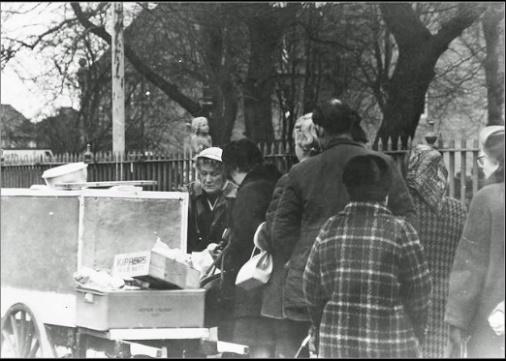
Once a week, the fish man would call by the street with his little van. Collecting his fish from North Shields, he was a popular caller with his small range of very fresh fish, locally smoked kippers, rollmop-baked herrings, and fishcakes. We would also often use the services of the two Cullercoats Fishwives who came up from the Coast on the Electric Railway to sell their locally caught produce. Many older residents will remember Lily Scott Finlay who stood for many years at South Gosforth station and later Lily Scott Finlay at South Gosforth at the bottom of the Grove or just opposite, outside St.Nicholas Church, and Bessie Brown who favoured Moor Road, later moving to the corner of Church Road and Harley Tce. They would cheerfully fillet their fish, barely watching what they were doing whilst chatting away profusely with their customers and tossing their fishy waste into the base of their barrows. They knew all their customers well since many were regulars who often left orders with them for the following week.
Everyday Life In The 1950’s
Ice Cream Sellers
In the early 50s, Mr.Whippy was still a dream idea, and ice cream sellers would come round the streets with their handcarts or small carts combined with a bicycle. Ice cream was kept frozen with the use of dry ice, which was frozen carbon dioxide, or in some cases the carts had rechargeable fridges. Commonly it would be the Wall’s ice cream man who would have rectangular blocks of ice cream and lollies to sell. Cornets were square to take these slabs, which also fitted nicely inside a pair of wafers.
These men were replaced a little later in the 60’s with Mr.Whippy and other branded soft ice cream vans who would offer their new soft product whilst boldly announcing their presence with the now very familiar sound of their chimes, loudly playing ‘Greensleeves’ . This would soon attract kids like the Pied Piper, from all around, having pestered their Mothers for money to buy a cornet or lolly. The tune is now almost synonymous with ice cream vans. Small people soon had the difficult choice to make as to whether they wanted a 99 flake , dragon’s blood or sprinkles on their cones, not to forget the crispy, slightly dearer sugar cone option.


What did everyday life in the 1950s and 60s really look like inside our homes? This glimpse into the past illustrates
The Butchers Boy
The butcher’s boy was one more iconic caller to our streets. His bike would have a large basket on the front for orders and often an advertising panel beneath the cross bar. He would very often be a man rather than a boy and would travel round with his newspaper-wrapped parcels of meat and sausages. Many shops were still quite happy to arrange deliveries at that time. Grocers would often drop off boxes of ordered groceries. Ours came from a grocer who had been in the Grainger Market for donkey’s years and had delivered regularly to my Grandmother’s family before us.
Social History of the 1960’s
The Chimney Sweep

Essential for us all in those days, with belching chimneys from our coal fires (no central heating then), was the chimney sweep. Earlier sweeps had cycled round with their brushes on bicycles, but by the 50s they were travelling about in their little vans. They would arrive with their rods and brushes and large thick dust sheets within which they trapped the soot. They would push their brushes up the chimney until the assistant noticed the brush sticking out of the chimney pot.
Occasionally, if a chimney had become ‘difficult’ to pass the brush up, they would climb on the roof and drop a large heavy ball down the chimney to clear any obstruction.
This was still early days and they hadn’t given way to the industrial vacuum cleaners that made the work a little cleaner in operation. Very easily identifiable by their very black, sooty hands and faces , it was considered lucky by many to have a chimney sweep at their wedding. A useful extra source of income for them.
Bob A Job Week!
Once a year, small boys would ring our doorbells squeakily announcing themselves with the words ‘Bob a job ’ This was the efforts of the local scout troop to raise funds where the scouts would carry out simple household jobs like a bit of shopping or maybe washing a car or a bit of weeding, in return for a shilling (a ‘bob’ …now equal to 5p) .
Other young visitors would come during the run up to Guy Fawkes night when groups of kids would call with their ‘guy’ that they had made, sometimes in an old pushchair or on a soap box cart with the cry of ‘ penny for the guy’. Halloween had yet to make an impact on Britain at this time but we children would usually hollow out a large turnip, cutting a face through, with a candle inside. The ‘trick or treat’ phrase had yet to make itself known so we would just roam around with our lanterns looking for witches. More commonly, these turnip lanterns were made for Guy Fawkes Night just a few days later. The rather pleasing smell of the burning turnip is very memorable and evocative of that period and never forgotten.
Christmas, of course, brought out the groups of carol singers and occasionally just a single very brave child on his or her own. Singing stopped immediately they got their money so if you wanted a bit more of a tune it was best not to rush with your payment.


Life in Post-War Britain
The Fish And Chip Van
Not seen in our street but a popular vendor in some parts was the Fish and Chip van. We tended to rely on the well-established local shop of Bob Young’s on Gosforth High Street, but some residents living further away from the high street were happy to see these vans that would regularly call and station themselves once a week. I recall one who used to stand by Regent Farm Road shops. Many were in converted buses, large old vans, or modified ice cream vans. Of course, chip shops always wrapped your food in newspaper and not fancy boxes like today. Not so hygienic perhaps, but nothing tasted better than fish and chips out of a newspaper dripping slightly with watered-down vinegar and salt, and of course, grease. Never tomato ketchup from the chippy unless you bought a tiny bottle from them! This was early recycling, and we would keep all our newspapers till a pile built up and then take them to the chip shop or perhaps the butcher or fishmonger. It was quite some time before some bright spark realised that perhaps this was not the most hygienic wrapping for food, and they started using plain, unprinted paper.


The Window Cleaner
The window cleaner made his regular rounds with his ladders and bucket, often walking, or some would use a bike. No cars with roof racks for him.. that all came later. Our window cleaner not only did his regular rounds but had cornered quite a sizeable chunk of Gosforth High Street where many of the shops liked their windows cleaned almost daily.
The Street Sweeper
The street sweeper was another common sight. With his two square bins fixed on a single axle, he would push this round the streets all day. He would have his broom standing upright on the front or sometimes fixed along the side, coupled with a shovel and his iron ’ rake ’. The latter tool was used to rake out the accumulated dirt in the metal channels set in the pavement leading from house gardens to the roadside gutter. Most of these lone sweepers would take pride in keeping their group of streets spotless. Now long since superseded by small motorised vehicles , both on the road and footpath, although the latter sadly mostly absent for some time due to council cutbacks.
 Gully Cleaner | RX06KNH
Coupled to these sweepers were, of course, the ‘gulley tank’ wagons. A large lorry vacuum cleaner and tank used to suck out the accumulated dirt and leaves gathered in the roadside drains and help to prevent flooding if they became blocked, followed by a good sluicing with a milky white disinfectant solution.
No doubt there are many other visitors/workers that I have yet to mention,but the above represent the main body of those that I recall from this era. © David Wardell visitors/workers
These seemingly ordinary visitors can tell us a surprising amount about everyday life around a house. The fish man, the butcher’s boy, the window cleaner or the chimney sweep were part of the rhythm of the street, appearing at familiar times and becoming recognisable faces to the people who lived there. Their visits reveal something of how households were supplied, how neighbours interacted and how people spent their days before many of today’s conveniences became part of everyday life.
During the research into a house’s history, it is easy to focus on the people who lived behind the front door. But a house was never an isolated place. It was part of a wider community, connected to the people who passed along the street, called at the door and provided the services that households relied upon.
These small details help bring a house back to life. They allow us to imagine not just who lived there, but what it might have felt like to live there, the sounds from the street, the familiar faces at the door and the everyday routines that made a house a home.
Looking beyond your own front door
Understanding who called at your house helps build a richer picture of everyday life.
When we research a property’s history, we don’t just discover who lived there. We also uncover the world around the trades they relied upon, the communities they belonged to and the changing neighbourhood outside the front door.
These everyday details help transform a list of names into the story of a home.